Por María Suarez Toro,
Feminist Elders Against Genocide (FEAG)
y Escribana
November 27, 2026
This afternoon, at 3:00 p.m. (San José, Costa Rica time), an “Italian woman named Albanese” was detained at Juan Santamaría Airport, with immigration authorities denying her entry into the country.
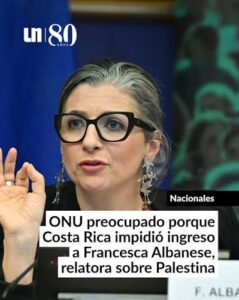
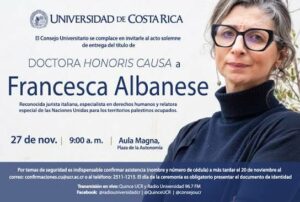
She had been invited to receive an Honorary Doctorate from the University of Costa Rica (UCR) in recognition of her distinguished work as a United Nations Special Rapporteur for Palestine.
Her work is so globally recognized that the only possible explanation for the statements made by the Director General of Migration and Foreigners, Omer Badilla Toledo—regarding the detention carried out by immigration police—is either sheer ignorance or malice. He justified the entry ban by citing “alleged links between Albanese and terrorist acts,” claiming that the decision was a matter of national security.
The officer never specified whether there is an ongoing criminal investigation into Albanese, nor did he cite the specific provision of Costa Rican law upon which this immigration denial is based.
Only two organizations in the country had spoken out against the awarding of this honor, bases on her “antisemitism”: the Zionist Israelite Center of Costa Rica (CIS) and a group called “Costa Rican Jewish Voices.”
Their arguments echo the international persecution the Special Rapporteur has faced for years—despite a complete lack of evidence to incriminate her. She has been systematically accused by Israel and the United States of having “links to terrorists.”
This media venue has learned of two *habeas corpus* petitions filed to prevent the Rapporteur from being unjustifiably removed from the country—one submitted by the *Frente Amplio* (Broad Front) party, and the other by the non-governmental organization Women’s International League for Peace and Freedom (WILPF).
In this regard, Costa Rican feminist lawyer Adilia Caravaca—who authored the *habeas corpus* petition on behalf of LIMPAL—stated to this that “acting based on an “alert” without a cited sources is not a valid justification; furthermore, restricting freedom of movement without such justification is unconstitutional.”
Having accepted the petitions, the Constitutional Court has given the Costa Rican authorities 24 hours to provide an explanation for their actions. The Constitutional Chamber has accepted the petition and given Costa Rican authorities 24 hours to explain their actions.
“I had a very long argument, surrounded by several immigration officers; it was a rather intimidating situation. Honestly, never in my life have I felt so humiliated and threatened,” the Special Rapporteur recounted to the outlet Delfino.com from the airport.
“Do not call me señora (‘ma’am’); if you do not wish to use my name, call me ‘rapporteur,’” she said, angered by the treatment she received when they attempted to put her on a plane back to Paris—an action she refused. She declined to be placed on a flight back to Paris, the city from which she had arrived. Her conduct before the Costa Rican authorities mirrored how she has handled international pressure from the Zionist lobby in the United States.
The UN Special Rapporteur for the Occupied Palestinian Territories has a courageous professional record—unrelenting in the face of genocide—which has led to unprecedented persecution by the governments of Israel and the United States.
There have been numerous reports of attempts to obstruct her public work, which is dedicated to the struggle to end Israel’s genocide against the Palestinian people. Her personal and family life has also been affected; a case won by her daughter in the United States is one example, alongside the death threats she has received due to her work. According to Al Jazeera, in 2024, Israel declared Albanese *persona non grata*, banning her from entering the country. Israeli officials—including the ambassador to the UN, Danny Danon—have harshly criticized her, accusing her of bias and antisemitism following her reports on Gaza and the occupied territories.
As of 9:00 a.m. the following day in Costa Rica, Francesca Albanese remains in custody. The airport was filled with people demanding her release and her entry into Costa Rica, all awaiting the outcome of a constitutional challenge that concludes today, marking the end of the 24 hours of arbitrary detention.
International and national media outlets, as well as various organizations, have reported on the situation. Today, *La Extra* of Costa Rica carries the headline: “International press puts Costa Rica under the microscope for denying entry to a UN rapporteur.”
The University of Costa Rica (UCR) had reaffirmed its intention to proceed with a recognition ceremony scheduled for today livr in absence of Albanese who heard it and received from her place of retention at the airport.
Yesterday, upon learning of the situation, the UCR University Council has stated that it “deeply regrets this situation” and reaffirmed its “commitment to academic freedom, the exchange of ideas, and the humanist vocation that has historically characterized Costa Rican academia.”
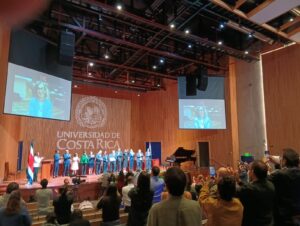 The University of Costa Rica (UCR) fulfilled its promise with integrity at 9:00 a.m. today, and the result was exceptional. The University Council met in full at its headquarters, surrounded by hundreds of students, professors, and university staff; meanwhile, hundreds more gathered in the vicinity of the airport, where Albanese remained in custody.
“You embody the highest human values… you urge us not to remain indifferent or take refuge in neutrality when human rights are under threat… defending them requires raising one’s voice in the face of injustice,” the Council stated in its address. Teresa Rosella, an assistant to the UN Special Rapporteur, accepted the award on her behalf. Amidst a prolonged standing ovation, preparations were made for Albanese to speak by phone. “We wish to be free—as your national anthem says, and as Juan Santamaría declared when he confronted the imperialism after which this airport is named.
Defending human rights is not terrorism; the Costa Rican government will have to answer for this false accusation. Atrocities are escalating in Palestine—in besieged Gaza—and I have become a chronicler of a genocide that seeks to completely conquer and occupy Palestinian territory, from the river to the sea. Responsibility for this genocide extends beyond Israel to include those who profit from it, as well as international media outlets that, through their complicity, help perpetuate it. Today, we must reaffirm our collective commitment to speak out, document events, and defend the truth itself. Historically, Costa Rica was one of the first nations to recognize Palestine at the UN; today, however, it risks its standing by deepening ties with Israel’s apartheid regime. I offer special recognition to the students of Costa Rica for upholding solidarity here. Ratifying a Free Trade Agreement with Israel would be a historical disgrace. Palestinians want to be free, not siervos menguados (“diminished servants” in Costa Rica’s National Anthem…”
The international community has also expressed its condemnation of this arbitrary action, calling on the Inter-American Commission on Human Rights to intervene in the case. Specifically, the Association of Human Rights Lawyers, Judges, and Prosecutors of Latin America and the Caribbean (AJUFIDH) requested on Thursday that the Government of Costa Rica reconsider its decision to block the entry of Francesca Albanese—the United Nations Special Rapporteur on the situation of human rights in the Palestinian territories occupied since 1967—and urged the Inter-American Commission on Human Rights (IACHR) to consider requesting an explanation from the Costa Rican state.
Víctor Madrigal-Borloz, a Costa Rican lawyer who serves as chair of the UN Voluntary Fund and is a former Special Rapporteur, questioned the detention of Special Rapporteur Francesca Albanese at Juan Santamaría Airport. “I have never had to deal with a situation in which a rapporteur was deprived of their liberty.” He explained that Special Rapporteurs are protected by the Convention on Privileges and Immunities and cannot be detained.
My Opinion
The refusal to allow the UN rapporteur to enter the country to receive an award illustrates—as noted by *El País*—”the new foreign policy direction of this Central American nation, which is now closely aligned with Israel and associated with the global policies of the United States.”
Enough with the hypocrisy and the government’s double standards—a classic case of “praying to God while wielding the club.” José Miguel Villalobos, a pro-government legislator who chairs the International Relations Committee of the Costa Rican Parliament, told local media: “Albanese is not Hamas. She has the right to come; she has the right to enter—whether she is right or wrong.”
President Laura Fernández—with that “who, me?” expression of an innocent little girl, which doesn’t suit her at all—stated that: “Respect for freedom of thought is part of that tradition. A person’s ideas should never be grounds for denying them entry into the country. The decision by immigration and government authorities is an unjustified affront and a slap in the face to the institutional tradition that once made Costa Rica an exception. It is an action that negates our very essence and brings us shame.”
Let her prove her stance by testifying before the IACHR, should the matter reach that level—and let her also re-examine the decisions they are making regarding the Zionist regime of Israel, by failing to demand anything of it.
In reality, through its treaties, its votes at the UN, its promises to relocate Costa Rica’s embassy—thereby facilitating the occupation—and its own domestic policies, the government is supporting a predatory state in its worst actions against freedom of expression in Gaza and Palestine; and, worse still, it is complicit in the violation of that people’s sacrosanct right to life, in the face of an unjustifiable, systematic destruction of their existence.