The delegation of women from Talamanca and their allies at the Congress
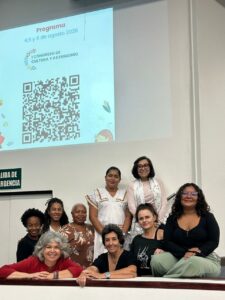
Organized by CCBEEM, INMAR Caribe, and the “Revitalizing” initiative, the group of 11 women included retired UCR professor Marianita Harvey Chavarria, Marya Jiménez Taysigue, president of CCBEEM, Patrizia Oliva from UNED’s CICDE, Karla Taylor from Manzanillo with her new project “Youth Defenders of the Seas,” Thalia Jiménez, a Ngabe from the Sixaola Transboundary Territory, Mariah Smith from the University of Oregon, who is writing her thesis on Cahuita and its National Park, Valeria Sisa and Alexa Sax from the musical group Son Semillas, María Suárez Toro from INMAR Caribe and CCBEEM, Constanza Rangel, an independent researcher and epistemologist, and Vilma Peña, a retiree from UNED.
They shared their initiatives, projects, and community strategies in Manzanillo, Puerto Viejo, and Cahuita in the Southern Caribbean, within the indigenous territories and communities of the region, and in other parts of Costa Rica.
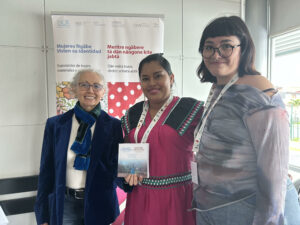
Photo of part of the delegation. 08/04/26
The women contributed ideas among themselves and with university students from at least four universities, faculty members from the University of Costa Rica (UCR), and Univeridad Nacional de Heredia (UNAH), university staff from
the UCR, national artists, and community activists from San Ramón, Limón, Talamanca, Guanacaste, S
an Gernónimo de Moravia, and other locations.
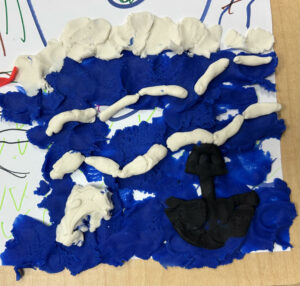
They shared updates on ongoing research related to heritage diversity, as well as its protection, management, and approaches—as was the case with CCBEEM President Maraya Jiménez, who was invited by the Research Center for Intercultural and Regional Studies (CIDICER) at UCR San Ramón to present the research, conservation, and experiences related to the underwater cultural heritage of Cahuita and its National Park, and her achievement in scientifically establishing the identity of the shipwrecks as Danish slave ships that brought African men and women to the Caribbean.
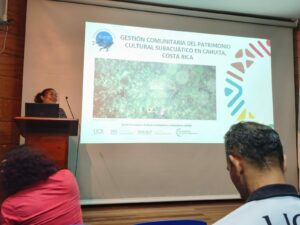
Several presentations during the working groups highlighted the special role of the Park’s co-governance in innovating its future Management Plan by incorporating underwater cultural heritage and the conservation of the seas as natural heritage that encompasses both underwater and coastal cultural heritage.
Members of the audience called for attention to be paid to the community’s needs in order to defend the Park’s co-governance.
Another research underway about the Park’s maganement of biocultural resources is Mariah Smith’s University of Oregon Masters Degree dissertation.
Maraya Jiménez at the CIDICER
panel during the Congress.
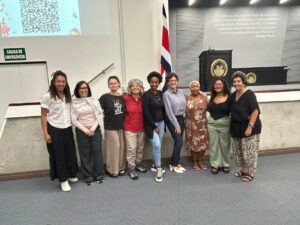
The delegtion met with officials from the Office of the Vice Rector (Dean) for Social Action, including Vice Rector Annette Calvo Shadid, whom they thanked for organizing the event and invited to visit Csribe in person, given that she is from Limón. The Office of Social Action (VAS) has supported the CCBEEM initiative and others within the The Sea and Its Benefits project for a decade and is currently exploring ways to continue supporting this and other initiatives of the delegation and the region, such as the “Remembranzas” project.
Photo of the delegation with the Vice Rector (Dean)
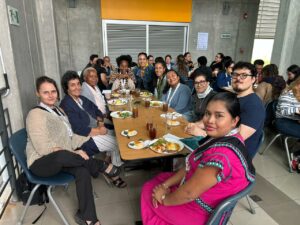
They also met with Adrián Castro López from the University Community Work (TCU) “Remembranzas,” with whom they are exploring ways to implement this project in the Caribbean through a visit this month. The work that the TCU will carry out in the Caribbean stems from a joint effort between various women community leaders and all community stakeholders from different territories, including Cahuita, Manzanillo, Puerto Viejo, and the Ngäbe indigenous territory. These are initiatives that share a common purpose: to strengthen identity, memory, cultural heritage, and the communities’ relationship with their natural environment, especially with the ocean. The projects are still in their early stages and will continue to be developed in collaboration with the communities. Therefore, this guide provides only a general overview that will be expanded upon during the initial meeting with the people leading each initiative.
Photo: Meeting with Adrian to plan the visit.
All the initiatives stem from the same idea: culture and biodiversity cannot be understood in isolation. The Caribbean’s identity is deeply linked to the sea, landscapes, ecosystems, historical memory, traditions, music, oral traditions, and the knowledge of communities. From this perspective, the Caribbean is not understood solely as a geographic space or a tourist destination, but as a living territory where natural heritage, cultural heritage, memory, and identity converge.
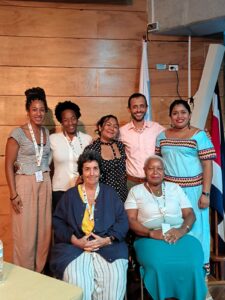
The delegation met with Carlos Rojas, director of the Center for Research on Interculturality and Regional Studies (CIDICER) at the UCR’s San Ramón campus, and agreed on how to coordinate their efforts through a visit this month. CIDICER has a long-standing relationship with CBEEM, as the Center published the book Tona Ina: La Luz en el Mar Caribe and hosted a delegation of the “ambassadors of the sea” at its recent First International Congress on Cultural Diversity and Regional Studies, held in September 2015 at the Western Campus , which focused on cultural awareness and globalization. On that occasion, the CCBEEM presented an academic paper on its research work, noting that communities have the right not only to know about and care for their heritage but also to research it. The plan now is to build on this by expanding collaborations with other related initiatives.
Photo of the Delegation with Carlos Rojas of CIDICER.
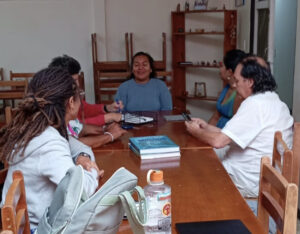
Likewise, the Delegation met with Jorge Polimeni, Technical Secretary of the National Environmental Council at the Costa Rican Presidential Office. in his capacity as coordinator from the OET for the implementation of the creation of the Marine Corridor between the PNC and REGAMA. They were briefed on the plans for its creation and agreed to help raise awareness of women’s projects in the area.
The Marine Corridor has met several times with community and municipal representatives to design a project with significant biocultural content aimed at protecting what the CCBEEM has referred to for the past nine years as “Puerto Viejo Sea: A Community-Protected Area.” Now this designation is being formalized.
End
More photos:
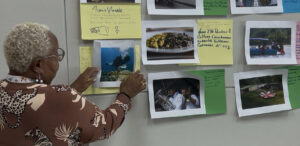
Event Overview
This gathering sought to strengthen the exchange of knowledge between the university and society, promoting processes of shared learning and social transformation. Within this framework, artistic and cultural practices were recognized as tools for mediation that contribute to community empowerment and the promotion of social change.
The Congress was conceived and organized as a space for interdisciplinary dialogue to share methodologies, highlight the results of cultural projects, and foster collaborations that strengthen social action efforts.
How?
By encouraging active participation from the university community and social actors in an interdisciplinary forum that highlighted efforts and promoted the strategic coordination of initiatives in the areas of culture and heritage.
It facilitated a space for co-creation among individuals from different disciplines and organizations, aimed at developing collaborative agendas around issues that impact culture and heritage.
It systematized contributions regarding knowledge and the interconnections of artistic, cultural, and heritage practices in Costa Rica.
Theme 1. Art and design in community contexts: situated practices, cultural mediation, and social impact.
Theme 2. Art education and pedagogies as tools for social transformation.
Theme 3. Processes of artistic creation and production grounded in inclusivity.
Theme 4. Connection to and appropriation of tangible and intangible cultural heritage.
Theme 5. Audience development and engagement in the arts.
Theme 6. Academic research and evaluation of cultural and artistic initiatives.
A series of artistic presentations, videos, works, and infographics will illustrate the various forms of expression, research, protection, and defense of cultural heritage.
Characteristics of the Talamanca Delegation
Their experiences and community projects are characterized by following and creating a specific epistemology and methodology that encompasses a network of diverse approaches and reflections, particularly: Citizen Science, Feminist Methodology with Situated Knowledge, Action Research, Multiple Perspectives (transdisciplinarity, inviting experts who share their expertise with the community), a focus on cultural, political, land, and other related rights, and Community Roots, where the processes and results…
…belong to the community group that spearheads the initiative (drawing on the community’s own capabilities), the defense of community cultural and intellectual property, and respect for the place of origin of the artifacts and culture being studied.
This approach to heritage is present in all of its initiatives focused on promoting active leadership by women, which encompass marine cultural heritage, ancestral and pre-Columbian Indigenous cultural heritage, and cultural heritage in dance, music, and scuba diving—with a specific focus on nurturing young women from childhood through adolescence.
The Delegation is composed of women who are driving currently ongoing academic and community research projects, as well as activist projects related to the management, preservation, and participatory stewardship by communities that are the heirs to cultural legacies on the seabed, cultural legacies that remain buried in lands inhabited by Indigenous peoples or in regional and national museums across the country, as well as youth and children’s initiatives focused on caring for the seas and coastal ecosystems.
We are deeply grateful to Acción Social Universitaria for organizing the event and inviting us; to Marianita Harvey for providing transportation to and from the Caribbean; to the Ecumenical Research Department (DEI) for providing lodging and hospitality; and to all the professors, activists, artists, students, and university officials, including those who assisted us with meals and housekeeping.