María Suárez Toro, INMAR Caribe,
On June 17, 2026 in Agua Caliente, Cartago, Costa Rica, six indigenous Bribri, Cabécar and Ngäbe women leaders in their territory in Talamanca and Sixaola met with two Costa Rican archeologists in a visit to one of the cradles of pre Colombian civilizations in the country.
The dialogue of saberes (ways of knowing) that emerged that day during the encounter was as fascinating as the nature of the site itself.
Agua Caliente in Cartago is a magical site where the serpent like Purires creek, a tributary of the Agua Caliente river, the majestic and active Irazú volcano and an profoundly energizing ancient Cacicazgo site present evidence of 2,000 years of asentamientos of pre-Colombian dwelling of the Hurtares peoples, one of the nine groups in the country.
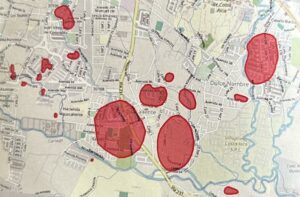
Map of some of the many places (red dots) identified in the area of Cartago that were occupied by pre Colombian indigenous peoples. The map in a booklet is courtesy of the archaeological excavation project “Cantos de Viento” (2024-2026) by Felipe Sol, Jessica Aguilar and David Sánchez.
A primera vista, la imponente belleza del paisaje ofrece una perfecta alineación natural y cultural entre el río, el volcán y el montículo del cacicazgo, capaz de dejar sin aliento a las visitantes.
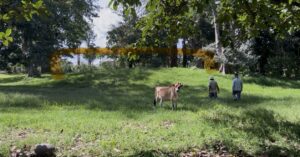
Yellow pilot mark of the extension of the main mound. Immediately behind it is the river and beyond the clouded sky is the volcano.Photo María Suárez Toro. 17/06/2026.
All five indigenous women, Bribri, Cabecar and Ngäbe and I were mesmerized by the site’s converging energies we immediately felt upon arrival to the site when archaeologist Uri Salas and our photographer Marcelo Gomez walked ahead of us into the mound.
“Cacicazgo (leadership role) was exercised by both females and males, as is evident around here, where we have seen and studied mounds of females that were highly decorated upon their burial – says archeologist Uri Salas – a symbol of honor in leadership”, concludes Salas, one of the archeological researchers of the site.
He added that the place presents scientific proof of 2,000 years of asentamiento where there is not a single piece of evidence of any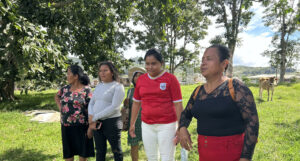 contact by those original civilizations with the colonizers; yet they probably left de place due to “the influence of the colonizers in the region”, says the booklet “Cantos del Viento 2024-2026”.
Thus, it seems that “influence” in this case does not mean direct contact or invasion, but context. It is well known that Cartago at the time became the major city of the Spanish Province of Costa Rica 1563 by Spanish conquistador Juan Vázquez de Coronado, becoming the first capital of the colonial rule until 1823 when it passed to be in San Jose.
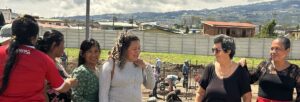
Left to right: Eulalia Thomas, Ngäbe, Jenni Mayorga, Mauricia Vargas, Bribri
Thalia Jimenez, Ngäbe and Olga Lupario, Cabécar. Photo Marcelo Gomez, 17/06/2026.
The 2,000 years of uninterrupted presence of the original peoples run in an uninterrupted Time Line up to abandonment of the site, as laid out by the aforementioned booklet of the project.
10,000 BC: First human evidence in the zone
1,000 AC: First farming groups arrive in the zone
300 AC: First families establish themselves in the zone
500 AC: Various families through various generations live permanently in the zone
900 AC: Large growth of the population and its political power, creating the cacigazgo.
1,569 AC: Abandonment of the site due to the impact of the Spanish conquest.
Past and Present Female Indigenous Leadership
The five indigenous women that visited Agua Caliente came from the southern most territory of Talamanca and Sixaola in Costa Rica are Bribri, Cabécar and Ngäbe leaders in their territories.
“My great grandparents always told me stories about having visited Cartago in the olden days even though this land is 300 kilometers away from my Finca Loroco in Bribri” says Mauricia Vargas Vargas, leader of her Kolwak clan of agricultural producers.
She explained that coming to the site in Cartago makes her very happy because she knows her ancestors were happy when they lived in the territory because the stories shared by them were stories of joy, community and abundance. “Today I feel happy here because the land still speaks to us about our peoples”, she concluded.
Another Cabécar and Bribri woman is Olga Lupario of the Duriwak clan, living in Alto Telire in the river bank of the Sixaola river that borders with Panama.
“Sibo gave us a beautiful weather in order that we could be here to see the places where Pabru Presbere (Bribi leader up to to 1710 when he was killed by Spanish colonizers) because it means that our footprint remains, not only there in Talamanca where we come from, but also here in Cartago. And yes, in our culture women are the ones who care for the seeds, preserve and continue the culture and the majority of things.”
Jenni Mayorga is a Bribri potter who also lives in Talamanca. “As a young alfarera potterer I have had to learn the inherited trade without any elder near me to teach it to me – she explains – so I have had to develop my skills drawing from my intuition and connection.” During the bus ride from Talamanca to Cartago that morning, she explained to me how she lets her hands guide her way into the same clay that her great grandparents molded, in order to let it speak to her, for example the color of the different clays have different ways of letting me mold them differently. “And this is now I look at how my work connects me beyond any feeling I have ever had about it ,because my ancestors are in it” she concludes.
Ngäbe young leader, Thalia Jiménez has come to the visit bringing her mother Eulalia Thomas along. “Despite the fact that colonizers wanted to eliminate us, there is evidence here that we have always been here, that we are still here and will remain here in our land. When I hear (the archaeologists) tell us about what they have found out about women, about the important role they played, I said YES, and I realize that we are still connected to those roles of leadership.”
The interaction between the indigenous women walking alongside the site and listening and reacting to the explanations of the archaeologists suddenly became a dialogue where history and lived experience met in an intensive moment of reckoning. At every explanation by the archaeological excavators, like “they used this pot to cook food…”, we would hear the women comment “…and still”. “They buried there, head head looking West”, said the archaeologist. “… and still”, we would hear the women.
At the seventh time where past and present met in lived experience, citizenship science being currently developed in Talamanca in underwater archeology also joined the interactive conversation. As co-participant
in the Talamanca underwater archaeology community project Ambassadors of the Sea, I asked Jessica Aguilar (an archaeologist in the site), the meaning for her in her interaction with the group of indigenous inheritors of the legacies in the archaeological objects and culture of the past that she is contributing to unearth and preserve.
Jessica displays human remains under study where assistants
clean them for analysis and preservation. Photo by Marcelo Gómez. 17/6/26
She explained that “the participation of the indigenous communities can be really very important because in enriches what we can say about the knowledge that we can give because then we not only explain objects, the findings and the things that we find, but the indigenous peoples can humanize the contexts (because) they provide information that we lack as researchers; they open many doors of knowledge, lived experiences and culture that we do not now an (this can happen) when they can participate in our projects.”
She added that when they as excavators find human bones they treat them with deep respect because they know they are her ancestors and those of our indigenous peoples. “ But at the same time we have to handle them because they provide much information about our cultures: illnesses, lives, death, ages, sex, what they ate, etc. They humanize the context” she concludes.
The Mamitas found in the Agua Caliente Site
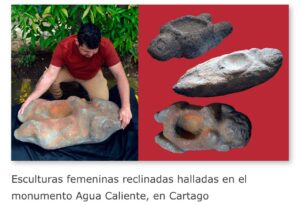
Three unique sculptures carved in stone depict reclining women with hollow bellies. They were found at the Agua Caliente archaeological site, according to archaeologist Luis Alberto Sánchez Herrera of the Department of Anthropology and History of the National Museum of Costa Rica in his article ”The origins of Everything: The Female Sculptures in agua Caliente, A Pre Colombian Town in Cartago”.(2)
In the article, as National Museum Supervisor, Sánchez lays out, the basic premises of what has been found between 2024 to the present in a private construction project that has organized and funded the necessary excavations, extractions and removal of objects found there.
Such is the legal process followed by any and every construction project that finds pre Colombian objects when they were going to begin building. They let the Museum of Costa Rica know, then the company hires professionals in the field of archeology to undertake a scientific study. The study is supervised by the Museum until approved by the National Arch
eology Commission (CAN) and the objects have been duly removed, classified and taken to the Museum for preservation. Only then can the construction proceed. Only once all heritage has been properly salvaged.
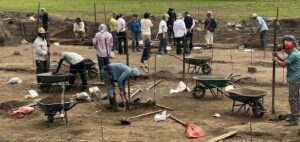
The Agua Caliente site. Photo Maria Suarez Toro, 17/06/2026.
About the particular female figurines found in the project, Sánchez states in his article that “more than fertility deities, these images appear to have a deeper meaning related to the beliefs and worldview of present-day indigenous groups in Costa Rica.”
“It is thought – Sanchez recognizes – that the “mamitas” were positioned in public and funerary spaces to perform specialized rites and permanently connect pre-Columbian communities with their stories about their origins and fundamental notions about creation, birth, life and death”.
 Ah, the cycle of the regeneration of the web of life. As I read Sánchez, my imaginary runs to meet my remembered information about the scientific connections that might stem from a regenerative paradigm, as interpreted by scholars such as Asian eco feminist Vandana Shiva in ecology about the seeds, of Lithuanian/USAmerican Marija Gimbutas in archaeomythology about Old Europe and Chilean Humberto Maturana in biology.
I find it also origins is what mythologists like USAmerican Joseph Campbell or Mexican philosopher and spiritualist Eduardo Meneches contributed regarding the fundamental notions about creation, birth, life and death.
It has also been a scientific contribution of Costa Rican anthropologist, Maria Eugenia Bozzoli, founder of the discipline in Costa Rica, when she named the cycle way back in 1979 in interpreting the mythology of the Bribri, in her book: “Birth and Death in the Belief System of the Bribri Indians of Costa Rica”.
The cycle is cast! The regenerative principle is more encompassing than “maternity” or “fertility” in isolation. It constitutes an expression of the full cycle of the web of life so that life continues in the Universe.
When Sanchez describes the present archaeological site in Cartago, he expresses the cycle of life mindset as follows: “According to the belief system of many indigenous groups on the continent, the female principle does more than receive, it also transforms what it receives; the seed is gestated in the earth (the woman), but she turns it into a sprout.”
That process of regeneration of the human species as such takes place in women’s bodies because we are a maternal, dimorphic species. The origin of all new human life and its regenerative cycle is embodied in her.
It therefore can be no surprise that she appears so often in the symbolic language of pre-historical mythological expressions. “Sculptures – warns Sánchez – had the particularity of transforming utensils for domestic use in works into amazing beauty, esthetic and symbolism”. To which we add that it is not only utensils, but the representation of the female body is full of symbolism also. Not as an expression of “motherhood” in isolation from the cosmovision of an egalitarian, animist society where all life is sacred and everything is life, has life.
Reductionist visions regarding women as isolated “wombs” and as sexual “fetiches”, does not do justice to ancestral frames of mind (paradigms), mythologies and symbolic expressions in times when female and males were equal; where biology and dimorphism was not antagonically split, but contained in the whole.
That is what Bozzoli documents that according to the Bribris, where Surá, the entity that governs the underworld that is forger of human beings is both male and female; and where life giving and regenerative forces were honored as sacred and veneered, not as in instrumentalized religion, but as expressing the animus or spirit of life in all living beings.
Sánchez recognized that when he gives due credit to Bozzoli, saying that “in studying these communities, anthropologist María Eugenia Bozzoli discovered an analogy between the role of the funeral officiant or gravedigger and the role of the pregnant woman giving birth. There is both opposition and complementarity between the roles of the woman and the officiant, as one delivers the child to the earth and the other to the underworld or the world of Surá. Both are necessary agents in the cycle of life and death and responsible for the continuity of the social group.”
In such paradigms, the human figure inspired sculpture at a time when pre Columbian communities reached their greatest civilizations, Sánchez also explains.
At least four examples stand out in his categories:
- The seate
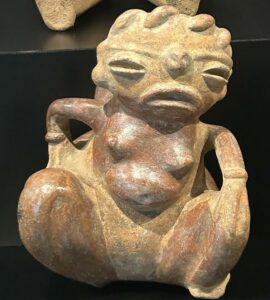
1. The seated poses, or “sukia,” perhaps the personification of a shaman.
Female shamans?
Photo in the Jade Museum in Costa Rica,
María Suárez Toro, June, 202
- The standing pose, which frequently alludes to a kind of warrior.
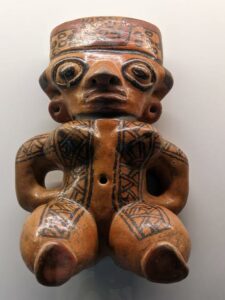
Female warriors? Photos above and below in the
Jade Museum in Costa Rica, María Suárez Toro, June, 2024
Yes! Fully acknowledged in the Jade Museum, as in this figure presented as unearthed in the Caribbean region in Costa Rica and dating between 1,000 – 1,550 AC. It reads that this “Human figure represents a female warrior, with her hands on her waist. She is naked, except for her belt and her elaborate headdress or hat”.
-
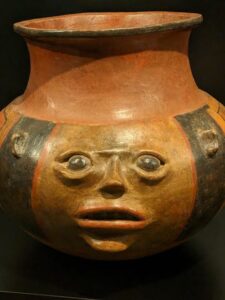 A figure of an independent human head:
Female or male head?
In the Jade Museum in Costa Rica.
María Suárez Toro, 2024.
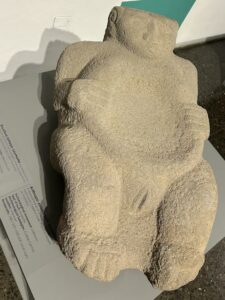 Reclining pose with a concave shape in her abdomen.
Mamitas in National Museum, photos by MST. May, 2025.
“Powerful entities connected to the Earth”, is the title of their presentation as “mamitas”, mostly from Costa Rica’s Caribbean.
The three other “mamita” figures that appeared in Agua Caliente are concrete, recent examples, as are the ones documented in the National Museum of Costa Rica and the poster that describes them.
The sculptures Recently found in Aguas Calientes
The three female sculptures of Agua Caliente seem to be the most recent archaeological re-discovery in a pre-Colombian site.
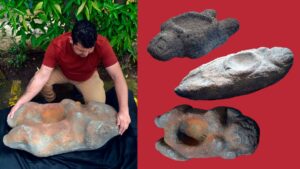
Apparently the name “Mamitas” cannot be traced back to any one person,” but a popular non academic term for the particular anthropomorphic female stone sculptures of females giving birth and/or concaved bellies”, according to Cleria Ruiz Torres, archaeologist of the National Museum of Costa Rica in a personal conversation with me on June 20th, 2026. She warned me that because they are andropomorphic, a few are male, although by far, most are female.
Photo in article by Sánchez quoted here.
Again, I go back to my imaginarios and the mythologies of our peoples. They knew so much about all the living beings that they interacted with without exaggerated separation based on human supremacism over the rest of the living world today ‘- that in their art,our ancestors probably wanted to remind us forever – less we forget – that males also have a place in the regeneration of the web of life even if it does not happen in their bodies.
Another interpretation can be that in the artist’s depiction of the cycle of regeneration in animal expressions, they knew that there are animal species where the male is the one that gives birth.
But back to the Mamitas. The Mamitas in Agua Caliente were carved from local stones and are quite different from one to another. Despite sharing the common image of a reclining female, each of the three “mamitas” appears very distinct from the others in terms of raw materials, execution, proportions, shapes, and finishes.
Sculpture 1 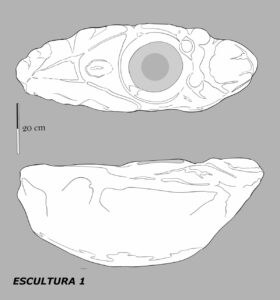
She is 92 cm tall,
she is elongated,
and her human features
are barely indicated.
When discovered,
her head pointed West.
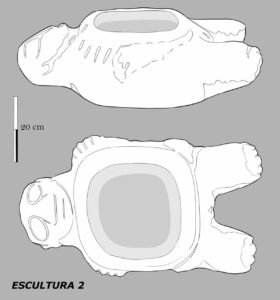 Sculpture 2
She measures 75 cm.
She is distinguished
by her rigid pose.
Her abdominal container
is rectangular and shallow.
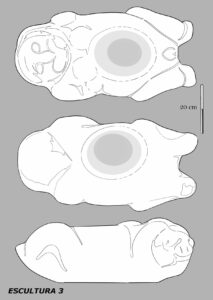 Sculpture 3
She measures 89 cm.
She exhibits a more rounded outline,
and a slight twist to its right.
The sculpture is also
characterized by having
a second concavity on the reverse,
as if the sculpture had been used
in two different periods.
Two of them are currently being exhibited in the Museum of the Municipality of Cartago near to the site where they were found.
According to The Times last June 2024 when they visited and interviewed the National Museum Director, Agua Caliente is a very important site. “Infrastructure such as mounds and causeways has been found there, as well as ceramics, vessels that came from Guanacaste in the Pacific, stone sculptures, and gold jewelry. Its occupation has been recorded over 2,000 years through villages of both natural and agricultural exploitation. During the pre-Columbian era, daily life and ceremonial acts took place there. The tombs have been key to investigating details of the original inhabitants”.
Future Plans about Agua Caliente
The Agua Caliente Archaeological Park Project seeks to transform a 10-hectare forest area donated to the Costa Rican Museum into what Uri Salas calls an open-air museum, a space for visitation, education, and heritage conservation.
The project has received 700 million colones in funding recently approved by the Municipality of Cartago and incorporates research into the important cemetery and ancient indigenous village located in the forest visited by the women of Talamanca and Sixaola.
“It also aims for the ecological restoration of the local river,” explains Uri Salas, adding that he hopes the Park will also feature plots of ancestral agricultural production “the same way you still plant corn and other crops” he told de Talamanca and Sixaola women.
The archaeologist expanded that members of the surrounding communities, the Municipality of Cartago, and the National Museum of Costa Rica are joining forces to develop a project at this site that will benefit nearby communities “and visitors like you” he underlined.
Through its focus on ongoing research—hopefully through citizen science—ecological conservation, and the promotion of the area’s cultural heritage.
The excavation project visited on June 17th was being supervised for the last time by a representative from the National Museum of Costa Rica. Between 2024 and this past June, the archaeological assessment and rescue work has been a private project in Agua Caliente de Cartago, where pre-Columbian residential structures and burial sites have been identified. This work is being carried out under environmental regulations and archaeological heritage protection guidelines as a private project.
However, it has provided impetus to the proposed state-owned collective ownership project for the forest next to the private land where the Mamitas were found and everything else recovered will then sent to the National Museum for preservation.
End
Reference
Sánchez Herrera, Jose Luis, “El Origen de Todo: Las Esculturas Femeninas de Agua Caliente, Un Asentamiento Precolombino en Cartago”, 2024. https://www.museocostarica.go.cr/divulgacion/articulos-educativos/mamitas-esculturas-femeninas-de-agua-caliente/